Showing posts with label ham radio. Show all posts

Tuesday, March 3, 2015

Crystals Go to War - 1943

One of the things that always fascinated me about radio was the ability to take discrete components and craft something that could pluck invisible radio signals out of the air. Once I learned more about electronics, some of the magic was replaced by admiration for the many generations of engineers and experimenters that had developed the radio art. Until recently, the theory behind crystals had not solidified (crystallized?) in my mind and so they remained one of those "mysterious devices".

The following film, like most produced during WWII, is a thorough explanation of the history and technology behind radio crystals. It was produced at a period when crystals were instrumental in securing reliable communications between military units, saving lives and coordinating the moment of supplies, troops and equipment.

I hope you'll find it as interesting as I did.

Sunday, December 1, 2013

Where to find the $20 Software Defined Radio?

A while back I wrote a blog post about the availability of $20 software defined VHF/UHF radios in the form of re-purposed USB digital television dongles.

Now-days, with the improvements in software and documentation, the hardest part is finding the right dongle. What you order from EBay, and what you receive, can be two different things and only some of the dongles are suitable for use as VHF/UHF software defined radios.

So, I was pleased to see that at least one hobbyist electronics supplier has sought out and supplies a suitable device for SDR at a fair price :
Adafruit has available the USB dongle and "antenna" suitable for experimentation for $22.50, not far from the EBay (direct from China) price.

Click here to go directly to the product page: Software Defined Radio Receiver USB Stick - RTL2832 w/R820T

No, I didn't receive a free evaluation unit and I don't work for Adafruit ... I'm just glad to see these useful devices available from a local company with an increased chance of you "Getting what you paid for."

Adafruit also helpfully stock the adapter cables to convert the less common MCX antenna connector into the much more common BNC connector: MCX Jack to BNC RF Cable Adapter

Tuesday, January 15, 2013

From Backblocks To High Seas

I came across this great piece of history via the Google+ page of Cristian YO8TNB and had to share it here for others to enjoy. I have a soft spot for New Zealand, being so close to my country of birth, and I particularly noticed the carefully cultured accent of the announcer. On a more serious note, this video is an invaluable record of the wired and wireless technology used in 1939 and the procedures for transmitting a message from land to sea.

Monday, July 9, 2012

The $20 Software Defined Radio

Introduction:

Despite my interest in boat-anchors I do find myself peeking 'over the wall' from time to time and taking a look at new and emerging technologies. After several demonstrations from friends I had become convinced of the incredible potential of software defined radios and even found thinking about owning one ... one day.

Perhaps the best known SDR in amateur radio circles are the FLEX rigs from FlexRadio. I had the chance to see a FLEX-3000 in use during Winter Field Day 2011 and had to admit that, barring the lack of knobs & dials, it was a very impressive rig!

One thing stopped me from running out and buying one straight away was the cost and perhaps the notion that once the new had worn off I would regret the significant outlay required to own the blue box. So, I shelved the idea of owning an SDR and found other things to occupy my time.

This changed when a post on www.reddit.com/r/amateurradio/ mentioned an unmodified digital TV receiving USB device that had been used as a software defined receiver in the 60MHz - 1.7GHz range. The best part was the cost, around $20 for most examples of this kind of device. Finally software & commodity hardware had come together to deliver useful receiver that everyone can afford.

The nuts and bolts:

There are specific parts required to put together your own $20 SDR but I will document what I used to get mine running and hopefully you can follow along.

Hardware: The device that I used was a Ezcap EZTV668 DVB-T Digital TV USB 2.0 Dongle purchased from DealExtreme. The part was shipped from Asia and I gather from reading else ware that DealExtreme is a middleman and not the actual supplier. Be prepared to wait a while if ordering from this supplier, my Ezcap took about 3 weeks to arrive but I have heard that a month or more is not uncommon.

The upside is that shipping is free and your purchase involves 0% tax, this really IS a $20 SDR.

This particular DVB-T dongle uses the RTL2832U chip which is required for use as an SDR, other dongles with this chip may work but if it does not have the RTL chip it will NOT work currently.

Software (Linux) : After poor results with the software running on MS Windows I moved across to Linux and got it working well there. I can't point you to a single howto for this because I used several different guides and tried a few things before it started working. The most helpful, and probably all you really need, are the build-gnuradio script which gets hardware support and gnu-radio running and the "Getting Started With RTL-SDR" page by Tom Nardi which covers installing Gqrx. All the software used is in development and requires familiarity with the command line to install and use at the moment.

Software (Windows) : I had another shot at getting the MS Windows software running and stumbled across the excellent website http://rtlsdr.org. Rtlsdr.org mentions using a new version of SDR# software which worked very well! 
I would recommend following the instructions under the Windows Software section, this had me up and running in a matter of minutes. Follow the instructions EXACTLY, I made life hard on myself by not paying attention to details and I think was responsible for my earlier issues.

Going further - Antenna : The stock antenna that is supplied with the Ezcap EZTV668 is sufficient for testing but you'll want to add something a bit more substantial for regular use. You may even want to remove the existing (hard to find) antenna connector from the board and install a standard connector and a less flimsy metal casing. This will help with RF shielding and temperature stability. 
If you are going to use a larger antenna, especially an outside antenna, you'll want to check to make sure a protection diode has been fitted to the input. The Ezcap EZTV668 is a very inexpensive device and others have found units in which the protection diode was not fitted to save costs.

Going further - 160M - 6M ? : I've just seen an interesting blog post titled FunCube Upconverter where the author, George Smart, has built a converter allowing the reception of 160M - 6M using the FunCube dongle. The FunCube is functionally the same as the RTL dongles available for $20. For any home brewers out there this could be a great project as George has included all the details including schematics and board artwork required to build the converter.


Update : Thanks to a link from Neil W2NDG to an EBay sale I've been able to track down a pre-assembled HF up-converter on this page : New HF Converter Kit for the SDR Fun Cube Dongle The price seems to be 45 euros, or about $55 US.

I've had a lot of fun using the $20 SDR to listen to AM aircraft traffic, local repeaters, emergency services and amazingly good quality broadcast FM stereo programming. Its easy to see, with an SDR, just how wide a radio broadcaster is transmitting and move your filter bandwidth to match.

Hopefully this is just the beginning of inexpensive SDR hardware that the radio community can re-purpose and re-engineer. 

Monday, June 4, 2012

The Johnson 275W Matchbox Antenna Tuner

I had purchased a Johnson Matchbox from an estate a while back & decided that while I was home with the flu I would open it up and check on its condition.

The Johnson Matchbox is found most commonly in two versions, the smaller "275W" unit and the larger Kilowatt Matchbox. Why did I use quotation marks around 275W? Well, these units were manufactured back in the good old days when men were men and transmitting voice meant using AM, not single side band. The conservative rating of 275W of AM translates into roughly 800W of peak SSB  (Not really but close enough so you get the idea)

Unlike many who own a Matchbox I was hoping to keep it 100% original and that it would contain all its original components, including the antenna change-over relay and wiring for the high-impedance receiver antenna connections. I plan to use this Johnson Matchbox with a Heathkit AT-1 transmitter and Hallicrafters SX-25 receiver so the inclusion of an antenna change over relay and 300 Ohm receiver connections will make life MUCH easier. Something I didn't realize until I had the unit apart (There are a LOT of screws holding this thing together) is that there is also a receiver control contact on the relay to break HT and mute the receiver during transmit which will work with my SX-25.

An initial inspection showed that the only modification was a small piece of plastic wedged into the relay contacts that held the relay in the transmit position. It was easily removed and the relay coil and contacts tested for continuity. The contacts seem a bit dirty which, from the little I have read online, seems to be a common problem.

Once the relay contacts and band-switch are cleaned I will button the unit back up and connect it to the loop antenna I have recently run around the eaves of the house. The loop has been a huge improvement to the long-wire and magnetic antennas I have run in the past, at least as far as reception goes ... but that is a topic for another post.

Saturday, May 26, 2012

Vacuum tubes could revolutionize computer chips?

No, I'm fairly sure I haven't lost my mind ... that really is the right headline.

According to a resent paper published in the American Institute of Physics, nanoscale vacuum "tubes" manufactured using conventional chip making techniques have operated at frequencies as high as .46 THz.

Dr. Meyya Meyyappan, Director at the Center for Nanotechnology at the NASA Ames Research Center, has highlighted the advantages of nanoscale vacuum devices which include resistance to hard radiation and significantly improved operating frequencies.

The increased operating frequency comes about because of the speed at which electrons travel through different materials. The speed of electron travel through silicon is comparatively slow, through graphine it is approximately 100 times faster and through a vacuum it approaches the speed of light.

While the cavity is not technically a vacuum it contains so few atoms of any other material, such as oxygen, it is functionally the same. This also gives the vacuum nanoscale device an advantage in space where hard radiation can disrupt an electron's travel through silicon leading to errors or sometimes permanent failure.

Dr Meyyappan estimates that vacuum nanoscale components will run ten times faster than the best conventional silicon chips and who knows what advances the future will hold. Faster chips will aid in signal processing and more capable software defined radios.

Do you want to monitor every CW & PSK31 transmission on the 40M band at once? With a vacuum "tube" rig you may be able to!

Wednesday, March 21, 2012

Ham Radio and Mesh Networks

Lately I've been fascinated by the capabilities of mesh networks. The ability to quickly create ad-hock computer networks could be an invaluable resource for amateur radio operators in general and particularly for emergency communications (EMCOM)

Linksys WRT54GL Router
The particular device and software I have been experimenting with is the Linksys WRT54G router and HSMM-MESH firmware from http://hsmm-mesh.org/.

Installing the HSMM-MESH firmware changes the way the Linksys router functions and allows it to automatically connect to other HSMM routers in a mesh network. No special configuration is required after setting your callsign. All TCP/IP configuration is pre-configured, even down to automatically assigning addresses to connecting clients.

Mesh Network Diagram
Mesh networks are highly fault tolerant. Every router in the network is aware of every other router and has the ability to move network packets through from one unit to another provided there is a link, or chain of linked routers, between them.
In the diagram to the right each router is represented by a numbered circle. If router number 6 were to fail then network packets that needed to move between router 1 and 7 would travel through routers 2 & 3 or 5 & 10 until 6 was repaired. All this happens automatically and quickly enough so that there is no disruption to the traffic.

Anything you can access on a normal computer network can be made to work on a mesh network. Some of the services that have been demonstrated include email, voice over IP (VOIP), video conferencing, file sharing, web servers & groupware applications.

With simple modified antennas the modest output power from the WRT54G (100 to 200mW) can be used to reach distances of many miles or tens of miles with directional antennas. Mounting the router on a mast in a sealed enclosure can reduce losses from long cable runs while running off 12V power makes them compatible with ham radio power sources including solar and wind power.

The example to the left is from NG5V located on hsmm-mesh.org and consists of an omni-directional external antenna and a lawn sprinkler controller box from a popular home improvement store.

Did you know that ... Frequencies used by channels one through six of 802.11b and 802.11g fall within the 2.4 GHz amateur radio band. Licensed amateur radio operators may operate 802.11b/g devices under Part 97 of the FCC Rules and Regulations, allowing increased power output but not commercial content or encryption.

I hope to acquire a few more WRT54G routers and put together a mesh network in the Katy TX area as a resource for experimentation and education in an area not normally touched upon by regular amateur radio operators. Who knows what the future holds & it behooves us to investigate this technology and bend it to our own needs.

The Amateur is Progressive ... He keeps his station abreast of science. It is well built and efficient. His operating practice is above reproach.

Monday, March 19, 2012

Geomagnetic data reveal unusual nature of recent solar minimum

An interesting article appeared on physorg.com yesterday regarding changes in the Earth's magnetic field and its relation to solar activity. Although short on detail it hints at significant changes going on within our sun.

Since the mid-1800s, scientists have been systematically measuring changes in the Earth's magnetic field and the occurrence of geomagnetic activity. Such long- term investigation has uncovered a number of cyclical changes, including a signal associated with 27-day solar rotation.

This is most clearly seen during the declining phase and minimum of each 11-year solar cycle, when the Sun's magnetic dipole is sometimes tilted with respect to the Sun's rotational axis. With the Sun's rotation and the emission of solar wind along field lines from either end of the solar magnetic dipole, an outward propagating spiral-like pattern is formed in the solar wind and the interplanetary magnetic field that can drive 27-day, and occasionally 13.5-day, recurrent geomagnetic activity.

Recurrent geomagnetic activity can also be driven by isolated and semipersistent coronal holes, from which concentrated streams of solar wind can be emitted.

During the most recent solar minimum, which took place from 2006 to 2010, however, several researcher groups noticed 6.7-day and 9-day recurrent changes in geomagnetic activity, and similar patterns in the interplanetary magnetic field, and the solar wind. Using modern data covering the previous two solar minima, these higher-frequency occurrences were judged to be unusual.

Love et al. analyzed historical geomagnetic activity records from 1868 to 2011 and find that the 6.7-day and 9-day recurrent changes were actually unique in the past 140 years. They suggest that the higher-frequency changes in geomagnetic activity are due to an unusual transient asymmetry in the solar dynamo, the turbulent, rotating plasma deep within the sun which generates the magnetic field.

More information: Geomagnetic detection of the sectorial solar magnetic field and the historical peculiarity of minimum 23-24 Geophysical Research Letters, doi:10.1029/2011GL050702 , 2012 

Provided by American Geophysical Union

"Geomagnetic data reveal unusual nature of recent solar minimum." 

March 19th, 2012. http://www.physorg.com/news/2012-03-geomagnetic-reveal-unusual-nature-solar.html

Sunday, March 11, 2012

PC power supplies for Amateur Radio equipment?

I've noticed a few spirited discussions regarding modifying computer power supplies for use with Amateur Radio equipment. On the surface it seems as though they supply the perfect solution: Inexpensive, high current, regulated 12V DC supplies for a fraction of the cost of specialized amateur equipment. Is it really is as straight forward as lopping off a molex connector and replacing it with an Anderson Powerpole?

By design PC power supplies are designed to output a fairly well regulated 3.3V & 5V to the PC motherboard and 12V to the motherboard, fans and hard-drive motors. Modern units are typically rated anywhere from 75W to 1200W which should be a measurement of the output power available from all the 3.3, 5 and 12 volts. Since this isn't a lab grade power supply you can expect marketing hyperbole has perhaps inflated the power output figures.

Back when my job was to build PCs I had an issue with a server not being able to start its complete complement of disk drives. When I opened the case I found a 300W desktop supply board had been used in place of the 800W board ... sometimes you don't even get what you pay for!

Before you convert your first PC power supply there are two issues that may, or may not, cause a problem depending on your unit.

The first is load regulation or the ability of the power supply to maintain its rated voltage under load. If the output voltage drops too far your rig will shutdown, distort or fail to provide its rated output power.

The second issue is due to the high frequency switching circuits used in switch mode supplies. Depending on the individual power supply there can be adequate to no filtering to prevent radio frequency interference being broadcast to your receiver. Toroids on the input and output lines can help to reduce interference.

Because of construction differences between models and even between batch numbers for the same model you can never be certain how the power supply you purchase, or recycle, will perform. For the most part people's experiences have been positive but I have heard of power supplies that were unusable because of RF interference or such poor load regulation that the 12V rail dropped to 11V under load.

Without a motherboard presenting a load and supplying the power-on signal there are a few changes that need to be made to the power supply. Modern power supplies will not enable the 12V output unless the power-on wire is grounded and a load should be placed on the 5V line to help with regulation. Additionally there is usually an adjustment that can be used to raise the voltage above 12V

The following links detail the steps required to convert a PC supply for use with amateur radio equipment. Whether this represents a good investment of your time will depend on your desire to do-it-yourself and the quality of the power supply you begin with. I've heard strong opinions either way but I'll just say that, if luck favors you, you'll save some money and learn a few new skills in this exercise.

Computer Power Supply Converted for Ham Use

CONVERTING COMPUTER POWER SUPPLIES (Advanced with theory)

Converting Computer Power Supplies to stabilized 13.8 V DC 20 A

Monday, March 5, 2012

DIY Magnetic Loop Antenna - Part 3

Well, I finally have had time to sit down and put together part three of the DIY Magnetic Loop Antenna, sorry it has taken so long!

This post will cover building and coupling the loop to your transceiver. After reading through posts one and two you should have a good idea of the parts you'll use and the physical dimensions of the main loop.

DIY Magnetic Loop Antenna - Part 1
DIY Magnetic Loop Antenna - Part 2

Most magnetic loops have the capacitor at the top of the main loop and the gamma match or matching loop at the bottom, this arrangement avoids running the feed-line through the center of the antenna.

You can assemble the main loop from continuous copper tube or from eight straight sections and 45 degree joiners. Make sure you have a blow torch or propane torch to solder the joints as you'll need more heat than a soldering iron can supply. Whichever way you decide to build the main loop make sure that all joints are soldered or clamped as securely as possible, you want the lowest resistance possible to avoid your output power turning into heat. Other materials can be used for the main loop such as aluminium or low loss coax but copper pipe is easy to work, has low resistivity and available from just about every hardware store.

To construct the frame of the antenna you can use PVC pipe. It is a cheap and relatively sturdy building material and is available in a range of thicknesses, just about any hardware store will stock a wide selection of fittings. It insulates well and can be glued once you are sure your project is in its final form.

Once the main loop is constructed you'll need to connect your capacitor to the two ends of the pipe at the top of the loop. Depending on the capacitor you may want to solder tags to the ends of the loop so they will be easier to attach. Copper pipe is a great conductor of heat and takes a lot to heat up and solder while it is not advisable to apply the same amount of heat to your capacitor.
It is also a good idea to attach the capacitor to a solid support so that the connections are not under strain.
The main loop and the capacitor forms the resonant circuit of the magnetic loop antenna.


To couple the main loop to your transceiver and match the expected 50 Ohms impedance you can use one of two methods. Probably the easiest is to use is a loop of insulated wire 1/5 the circumference of the main loop. The smaller loop is placed at the bottom of the main loop and can be shifted around to provide the best match. If you have an antenna analyzer you'll be able to set it to the desired frequency, tune the variable capacitor for resonance and then move the small matching loop around till you have achieved close to 1:1 SWR. If you don't have an antenna analyzer you can tune the capacitor for the greatest received noise and then on low power tweak the capacitor and move the coupling loop around for best SWR. Do NOT touch the loop while it is transmitting, use a wood or plastic rod to make adjustments as there are high voltages and intense RF fields near the loop.
An alternative to the coupling loop is the gamma match. The shield of the coax feed cable is connected to the base of the main loop while the inner conductor is connected to a point approximately 1/5 of the circumference around the loop. Its a good idea to use stiff wire (large gauge) for the gamma match as it can be critical of the position and orientation and once you have it in the right position you won't want to move it again.
It would be preferable to have the ability to remotely tune the loop. A motor with a reduction gear could be used to move the variable capacitor but because the point of resonance is very narrow there should be a way of slowing the motor down. A simple control circuit using variable pulse width modulation could be used to slow the motor down while still retaining enough torque to move the capacitor. Whatever method is used to move the capacitor it should be well insulated from the other components of the antenna. Several thousand volts are generated on the MLA and care should be taken to ensure they don't find their way onto control leads and back into the shack. Control leads should also be wrapped around toriod inductors as they leave the near field of the antenna to reduce the possibility of RF travelling along them.

With a SWR bridge and microcontroller you could build a fully automatic tuner that swept through the range of the tuning capacitor when the SWR rose above a defined limit indicating that the transmit frequency had changed.

With a little creativity and knowledge you could have an impressive MLA the equal of multi-thousand dollar military style units.

Hopefully this has given you some ideas for constructing your own loop antenna. Regardless of if you go top-of-the-line and buy a vacuum variable or build for economy and QRP you'll have a compact, useful and unique antenna.

Tuesday, February 28, 2012

What has been happening?

Anyone looking at my blog could be forgiven for thinking that I had dropped off the face of the earth for a while, has nothing been happening in my world?

Well, the answer is that a LOT has been happening and all at once. My daytime job has become busier and there have been several non-radio projects at home that needed to be completed. All this has kept me away from Amateur Radio blogging even though I have spent more time on the computer than usual.

In between projects I did manage to stumble across this video of Rear Admiral Grace Hopper explaining just how "long" a nano-second is and what it looks like. This has relevance to radio as we're usually well aware of frequency and wavelength but don't usually spend too long thinking about speed.


From Wikipedia : Rear Admiral Grace Murray Hopper (December 9, 1906 – January 1, 1992) was an American computer scientist and United States Navy officer. A pioneer in the field, she was one of the first programmers of the Harvard Mark I computer, and developed the first compiler for a computer programming language. She conceptualized the idea of machine-independent programming languages, which led to the development of COBOL, one of the first modern programming languages. She is credited with popularizing the term "debugging" for fixing computer glitches (motivated by an actual moth removed from the computer). Because of the breadth of her accomplishments and her naval rank, she is sometimes referred to as "Amazing Grace." The U.S. Navy destroyer USS Hopper (DDG-70) was named for her, as was the Cray XE6 "Hopper" supercomputer at NERSC.

Tuesday, February 21, 2012

DIY Magnetic Loop Antenna - Part 2

Part 1 of the DIY Magnetic Loop Antenna covered mostly theory and materials so now its time to move on to designing the magnetic loop antenna (MLA).

If you have priced a commercially made MLA you'll see prices start at $400 and keep going up, and up. If they cost so much you would think they must be difficult to build or use expensive parts, right? Well, it is certainly possible to spend more and get a higher quality MLA but a low cost MLA will still work very well.

For the purposes of this article we'll assume that you want to build a loop to cover the 20-10M bands. I'll run through the calculations required to build the MLA.

The required information for the MLA calculator is:
  1. Length of the loop
  2. The conductor diameter
  3. Frequency/s of operation
  4. Input power to the antenna
Lets pick some starting values
  1. We don't really know the best length of the loop at the moment so I'll pick 9 feet circumference as a starting point (It'll still fit in the trunk of my car)
  2. Since we seem to be having better luck with sunspots now I'd like to try 10M so we'll start with 29 Mhz as the highest frequency we'll use.
  3. I have some copper pipe left over from an ice-maker install, it is 1/4 (0.25) inch in diameter.
  4. Input power to the loop will be 100W.
Using the 66pacific.com calculator we get the following:
The comments section informs us that, "The specified conductor length is not idea" and we can go on to read that, "To avoid self-resonance, the conductor length for a small transmitting loop antenna should be less than 1/4 wavelength (less than about 8.23 feet at the specified frequency of 29 MHz)."

Well, I don't want the wire in the loop to resonate by itself, its designed to resonate in combination with the capacitor. Lets make the loop 8 feet in circumference and while I'm at it I'll make it out of 3/4 (0.75) inch copper pipe for better conductivity.

Lets see what we have now:
Well, that seems to have fixed the self resonance issue and we've managed to bump up the antenna efficiency to 91% from 82% ... not a huge increase ( About 0.5 dB) so I could use either diameter copper tube in this case. Everything looks good so far!

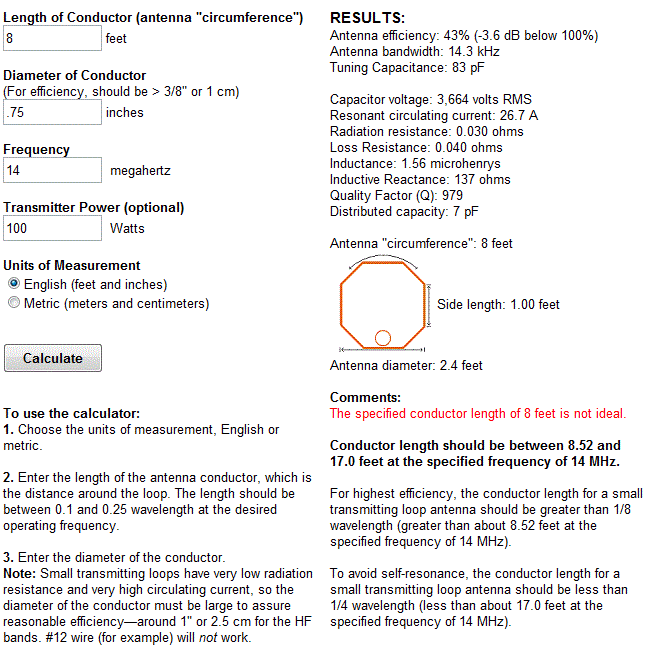
How about the 20M band, at 14 MHz how do things look?
So, the specified conductor length is not ideal but the comments section says were under the 1/4 wavelength at 17 feet. What is also tells us is that, "For highest efficiency, the conductor length for a small transmitting loop antenna should be greater than 1/8 wavelength (greater than about 8.52 feet at the specified frequency of 14 MHz)." 

That is OK, we know that the MLA is going to be less efficient somewhere in its range and the suggestion of 8.52 feet is close enough to our 8 feet we can ignore it. The 42% efficiency is not the greatest but -3.6dB is about half an S-Unit down so I'll live with that.

Just for fun I changed the copper pipe back to 1/4 inch and the efficiency dropped to 20% (-7 dB) so I think I'll stick with 3/4 inch. It makes more of a difference at lower frequencies since more current is flowing through the loop!

In order to tune the loop between 14MHz and 29MHz we look at the Tuning Capacitance value in the last two calculations above. At 29 MHz the tuning capacitance required is 19 pF and at 14 MHz it is 83 pF. 
This is well within the capacitance range of a normal air variable capacitor and in fact a larger capacitor with a maximum capacitance of 160 pF would allow you to reach the 30M band with reduced efficiency. 

Its important however to look at the voltage across the capacitor in our last two examples. At 29 MHz we'll see a Capacitor voltage of 2,562 volts RMS and at 14MHz we'll see a Capacitor voltage of 3,664 volts RMS.

What does this mean? In order to know what kind of capacitor would be best we need to know the absolute maximum voltage it will have to withstand before it arcs between the closest conductors. If the voltage is high enough it will 'leak' between the plates of the capacitor by breaking down the air between them and directly passing an electric current ... we don't want this to happen.

The breakdown voltage of air is around 3000V per milimeter (39/1000 of an inch = 1 mm). The voltage above is shown as RMS (Useful for power calculations) but we need to know the peak value which is higher and determines the maximum voltage. The peak voltage = RMS x 1.414 or 3664 x 1.414 = 5181 V peak. 

A peak voltage of 5181V will require a minimum spacing of 1.7 mm (peak voltage / breakdown voltage per mm) between the closest conductors in the capacitor. That would rule out an old air spaced variable capacitor from a vacuum tube radio but you could still use a wide spaced variable capacitor from an antenna matching unit or transmitter. A vacuum variable capacitor would be great (watch the minimum capacitance) or a home-made capacitor would also be fine provided you checked the breakdown voltage of the insulating material.

What if all you have is a capacitor with insufficient plate spacing for that voltage? If you reduce the output power to 35W then the voltage across the capacitor will decrease to 2168 V RMS which is 3066 V peak( 2168 x 1.414) This voltage requires a 1 mm plate spacing which is easily achievable with surplus capacitors. At QRP power levels (5 W) the voltage falls to 1160 V peak and requires only 0.39 mm between the plates, suitable for practically any variable capacitor!

The value of 3000V / mm is only an approximation and if possible use a capacitor rated for a higher voltage than you expect to run to prevent damage to your radio. Modern rigs have great protections circuits but they shouldn't be relied on.

Next post I'll cover building the loop and coupling it to your transceiver. Hopefully you found this information useful and if there are mistakes or inaccuracies you'll drop me a line and set me right.

Friday, February 17, 2012

DIY Magnetic Loop Antenna - Part 1

Do you live in a neighborhood with a restrictive antenna policy and despair of having a useful HF antenna?

Can you solder or know someone who can?

A magnetic loop antenna may be the answer and they are not as difficult to build as you might think. Like getting on the air for the first time or taking your license exam there is a certain amount of uncertainty when you first approach magnetic loop antennas, there are a few new ideas to grasp. However, thanks to other hams like Steve AA5TB there are tried and tested designs, calculators & building methods that are known to work and that you can follow.

At the heart of every radio and MLA (Magnetic Loop Antenna) is the resonant circuit. The combination of an inductor (a wire has inductance, but a coil of wire has more) and a capacitor (two conductors separated by an insulator) in a circuit will resonate or 'ring' at a certain frequency. Sound vibrations at a certain frequency can cause a piano string to vibrate in sympathy and a vibration of the correct radio frequency will cause a resonant circuit to electrically vibrate in sympathy.
Since there is no such thing as a free lunch, the sacrifice you make with a MLA is that it needs to be re-tuned whenever you change frequency on your transceiver. The frequency range over which it is resonant is very small, typically only a few hundred kilohertz at the most.

The materials you can get your hands on is going to decide the capabilities of your MLA. Ideally you'll have a loop made from a conductor with very low resistance (usually copper) and a capacitor that can handle high voltages. A variable capacitor is required if you want to use your antenna on multiple frequencies but you can use or make a fixed capacitor if you operate on one frequency, for Eg PSK31.


A MLA calculator like the Excel spreadsheet from Steve AA5TB or this web page from 66pacific.com will help you to decide what size components you'll need to make your antenna.

The four pieces of information required are:

  1. What frequency or frequencies do you wish to transmit on?
  2. How large do you want the loop to be (It should have a circumference less than 10% of the design frequency wavelength, both calculators help you figure this out)
  3. The diameter of your conductor (Three quarter inch (0.75 inch) copper pipe is a good start)
  4. How much power you want to use (The voltage across the capacitor is proportional to the input power to the MLA)
A MLA of a certain circumference will be more or less efficient based on the frequency you transmit at. It is worth changing the loop size in the calculator to get the best efficiency possible in your favorite band. 
For example, my 30-10 Meter loop is 8.5 ft in circumference and 23% efficient at 10.1Mhz but 91% efficient at 28Mhz. This represents a difference of about 6dB or 1 S-Unit.

The diameter of the conductor determines its resistance and this becomes important due to the large current flowing through the loop. Large diameter copper pipe is better since the radio frequency current flows primarily on the outside of the conductor rather than the core. Typical 3/4 inch plumbing pipe is a good balance between low resistance and weight, Heliax coax is good for portable antennas where the loop has to be rolled up into a compact space.

Probably the most problematic part of the MLA is the tuning capacitor. While everything else can be found in your junk box or on a shelf at the local hardware store the capacitor takes a little more digging. Ideally it should be variable from a minimum to a fairly high capacitance (0-300 pF would be good) it should also be able to withstand high voltages. If you are planning to run 100W then you could expect at least 4000 volts across the capacitor. This is not as bad as it sounds as it takes 3300 volts to jump just 1mm or .04 of an inch.

Ideally you could purchase a vacuum variable capacitor, the Rolls Royce of high voltage variable capacitors. You would expect to pay anywhere from $100 up when buying a 10 - 500 pF unit on Ebay and a LOT more if you buy new. If that is the way you want to go then great, you're all set. If not then read on ...

There are several alternatives to the vacuum variable capacitor that will work almost as well. The primary concern now becomes resistance and plate separation. For QRP power levels you can use the tuning capacitors from old vacuum tube radios, the type that have a set of fixed metal plates and a set of moving plates that mesh into them.
For higher power there are two other types of capacitor that are suitable. 
One is the split-stator capacitor, so called because each terminal of the capacitor is connected to a stator that is electrically isolated from the other and the frame. The rotors and shaft form the rest of the circuit so there is very low resistive loss and no sliding contacts.
The other type is called a butterfly capacitor due to the shape of the rotor plates. In this type the stator plates are placed opposite each other with the butterfly rotor in between. When each of the butterfly "wings" are fully meshed between the stator plates the capacitor is providing maximum capacitance, when rotated 90 degrees the wings are completely un-meshed and the capacitor is providing minimum capacitance. Because of the construction of butterfly capacitor there is a higher minimum capacitance that should be noted when planning the frequencies your loop will cover.
If all else fails then you can construct your own variable capacitor. The idea is to have two conductors separated by an insulator, the larger the area of the conductors and the better the insulator the higher the capacitance. Sliding metal plates, trombones of copper tube and even Coke cans have been used as variable capacitors.

A fixed capacitor can be created out of coaxial cable if you intend to operate on one frequency and a table of approximate capacitances for different types of coax is included here, click to enlarge the table below.

You can cut a length of coax a bit longer than the length suggested by the table above and trim it to frequency once it is attached to the loop. Make sure there are no stray pieces of braid between the shield and the center conductor as the voltage rating is determined by the spacing of the two closest conductors.

Part two of this post will continue with calculating the antenna dimensions and performance.

One important thing to remember ... If you don't have access to the best materials then use what you have and improvise. If you don't have copper pipe then use coax or heavy wire. If you don't have a high end variable capacitor then use what you can find and keep the power levels QRP. The only antenna that is a complete failure is the antenna you never get around to building.

Sunday, February 12, 2012

Heathkit's first amateur transmitter - Heathkit AT-1

The Heathkit AT-1 represents the commercial embodiment of the simple Master Oscillator Power Amplifier (MOPA) transmitter using a crystal controlled 6AG7 oscillator plus a 6L6 final output tube.

Although it was possible to design and build a simpler transmitter, the goals of output power and stability could become mutually exclusive when trying to operate with only one tube. For a novice class license holder of 1951 the Heathkit AT-1 represented a solid performing rig that would be relatively easy to construct and operate.

The Novice remained the primary entry license until the Morse code requirement was eliminated for Technician licenses in 1990. On HF it permitted code transmissions only, with a maximum power of 75 watts, (input to the transmitter's final amplifier stage) on limited segments of the 80, 40 and 15 meter bands.

For $29.50 and the loan of a few tools you could get some use out of that new novice license
The earlier MOPA circuit from the ARRL handbook of 1941 below shows a layout remarkably similar to the circuit of the AT-1 although it is designed for plug in coils rather than the band-switching arrangement of the later Heathkit transmitter.
MOPA transmitter using a 6L6 and an 807 as the power amplifier (ARRL Handbook 1941)
For a little added complexity MOPA transmitters generally offered better stability of frequency and keying waveform than single tube crystal controlled or self exited rigs. The straight forward design of the AT-1 should have looked familiar to novice class hams after studying the ARRL handbook or other radio publications.
Heathkit AT-1 Circuit diagram showing band-switching arrangement and link coupled output
Once the novice had upgraded his license the AT-1 could be expanded by the addition of the Heathkit VF-1 variable frequency oscillator to allow transmission on any frequency within the allowed band.
The Heathkit VF-1 Variable Frequency Oscillator
The VF-1 covered 160-80-40-20-15-11-10 meters and used an OA2 voltage regulator tube to provide a stable voltage for the oscillator. Ceramic coil forms, solid construction and high quality components were used to help increase stability.

It was recommended that to correctly couple an antenna to the AT-1 you would use an antenna coupler such as the Heathkit AC-1 which also included a low pass filter.

The Heathkit AC-1 Antenna Coupler. Designed to attach to a single wire by the insulated post on the front panel.
Heathkit AC-1 Antenna Coupler circuit diagram
Although Heathkit did not produce a AM modulator for the AC-1 there is provision for modulator connection on the rear panel. The earlier ARRL manuals have several suitable circuits for modulators that would work with the AC-1. Most functioned by driving a modulation transformer with the output from an audio power amplifier. The secondary of the modulation transformer would be carrying the DC plate supply for the power amplifier tube plus or minus the instantaneous voltage of the audio waveform. By changing the plate voltage to the final amplifier tube the radio frequency output would be controlled by the amplified audio frequency resulting in amplitude modulation.

Wednesday, February 8, 2012

Virtual Tour of W1AW, the Hiram Percy Maxim Memorial Station

Virtual W1AW Tour on Sunday, February 12 at 5 PM EST (2200 UTC)

Join W1AW Station Manager Joe Carcia, NJ1Q, on a virtual tour of W1AW, the Hiram Percy Maxim Memorial Station, the Amateur Radio station at ARRL Headquarters in Newington, Connecticut. Carcia will lead this tour via a live webcast on . Anyone with an Internet connection will be able to watch the tour here.

W1AW - The Hiram Percy Maxim Memorial Station

"We want viewers of this live Internet tour to feel as if they are actually at W1AW," Carcia explained. "If you came to W1AW in person, you would see the same things that we are going to show on the virtual tour: The three operating stations, the W1AW workshop, the transmitter racks that we use to send out our bulletins and use for the code practice transmission, the control console and Old Betsy, Hiram Percy Maxim's personal spark gap transmitter."

Al Petrunti, KA1TCH, of the New Day Group, will follow Carcia as he leads viewers through the station. ARRL Staff members, including Media and Public Relations Manager Allen Pitts, W1AGP, and Chief Operating Officer Harold Kramer, WJ1B, as well as local television weatherman Geoff Fox, K1GF, will also be on hand at W1AW during the tour.

"Hams around the world know of W1AW, and thousands have made contacts with this impressive station -- but most hams never get to see it," Pitts said. "Thanks to Al Petrunti's group, we hope that folks enjoy seeing what's at the other end of the signals. As in all live broadcasts, you never know just what might happen. We invite you to join us." Pitts is producing the live web tour.


From the ARRL Letter, available at http://www.arrl.org/arrlletter?issue=2012-02-09

Sunday, January 29, 2012

Winter Field Day and a Magnetic Loop Antenna

Last Field Day I spent a fair bit of time taking photographs and video which made for an entertaining record of the event when uploaded to YouTube. This time I was determined to do something more in tune with the Field Day theme and actually get my hands dirty ... or possibly burnt, cut or crushed (Physical coordination not being my strong point). Fortunately I only sustained one small scrape in the course of constructing a magnetic loop antenna for the 30 - 10 meter bands (A frequency range can be measured in meters since wavelength is directly proportional to frequency, a frequency of 7.49 million cycles per second has a wavelength of 40 meters at the speed of light). I had finished the antenna construction Saturday evening but the 20M band had fallen silent as ionospheric conditions favored the longer wavelength bands like 40M ... which the antenna didn't cover.

On Sunday morning the 20M band opened up again and I was able to make contacts all over the US using 10 - 25W. If you stop to think how far the light from a 25W light-bulb can reach it puts the fact that I could talk all over the US, using the same amount of power, into perspective!
My loop antenna is a simple resonant circuit: Consisting of a loop of copper connected to a variable capacitor. A smaller matching loop inductively links the transceiver to the larger copper loop so the radio see the right load.

The devil is in the details of course but I'll save a discussion of theory and construction for another post. There was a fair amount of interest in the loop as other folk also live in similar antenna restricted neighborhoods and are prohibited from putting up large antennas for the HF bands. Another ham brought out a very fine commercial loop antenna with a flexible loop that could be packed into a netbook sized bag. Such an antenna could be just the thing for trekking with a radio and operating in the great outdoors.
Seems I didn't learn my lesson with cheap coax ... The short piece that connects the wire matching loop to the longer cable run was a piece of RadioShack brand with a PL-259 connector conveniently attached. As I started started to transmit I noticed the SWR (Reflected power ratio) start to rise the longer I transmitted. As soon as I stopped for a moment it quickly dropped so I knew that whatever was getting upset had to have a fairly small thermal mass ... it wasn't the tuning capacitor for sure! I'll have to swap out the short piece of coax for a SO-239 socket and run my good coax directly to the antenna. While I was testing and making a few field day contacts I kept the power level low which kept the SWR under control.


Tonya added her baked creations to the Field Day menu and I suspect we may have beaten last years time in consuming everything apart from one slice of apple pie which lasted until Sunday morning. We were extremely well fed with delicious food thanks to many contributions with special thanks to Mike N5TGL and his wife who hosted the event and tolerated our impromptu lectures and animated discussions of ham radio miscellany for the two days of Winter Field Day.
The Society for the Preservation of Amateur Radio is the organizing body that schedules this event for the last full weekend each January. The object of the event is familiar to most Amateur Radio operators: set up emergency-style communications and make as many contacts as possible during the 24 hour period. The rules encourage as many contacts on as many bands and modes as possible, because during a real emergency, the most important factor is the ability to communicate, regardless of band, mode or distance.

Thursday, January 26, 2012

ARRL President Kay Craigie, N3KN presents an insightful and inspiring talk about Amateur Radio

Lately I have been giving a lot of thought to the notion that, as a amateur radio operator, I should be engaged in this or that activity ... should volunteer for something ... should be building equipment ... should be operating more ... well, you get the picture. I enjoyed the following video because it highlighted the variety of experiences in amateur radio and how each has value to the community in its own way.


If you talk to any group of ham radio folk (or read through a ham radio publication) you'll always run the risk of feeling that somehow you're just not doing enough stuff and that you're not holding up your end of the deal. The FCC made allowances for you to operate on several bands of frequencies which are set aside for amateur radio use ... you really should be using them right?
The answer to that ... as far as I now think ... is yes, and also maybe. To be perfectly honest I do enjoy getting on the air from time to time and making contacts, usually digital as I don't seem to have an ear for picking out SSB voices from the noise. However ... there are other things like vintage vacuum tube equipment, experimenting and the history of ham radio technology that I enjoy more.
I came to realize that, much like genetic diversity, a ham radio club that has members interested in a wide range of things could potentially be more robust and offer a greater service to the community and its members. There is one critically important caveat here however and it has been the downfall of several special interest clubs in the past. In order for a club with members having diverse interests to survive and thrive there must be a significant amount of tolerance shown by each and every member. We are both united by a common interested and made unique and interesting by the variety of ways that common interest is manifest.
If you don't operate QRP then stop a moment and talk to someone who does, if you only operate CW then chat to someone who operates digital modes or phone. Different disciplines can always benefit from a little cross traffic and you may be amazed at what you learn!

Tuesday, January 24, 2012

Pop's Shed and the Kingsley Radio AR7

After my grandfather passed away I spent a lot of time recalling the good times I had spent scrounging around his CB shack and hanging out with Pop "down the shed". If you've spent time around old motorbikes, retired lawn mower engines, vacuum tube electronics and inches of dust you know what the shed smelt like and probably have a pretty good idea what it looked like as well.  I used to be able to send Mum into fits by embedding a combination of oil, grease, dust and grinding compound into the knees and sleeves of my good clothes after spending the day "over south" (South Geelong)

Even now I can still walk into any old auto mechanics and the smell brings back dozens of memories as clear as day ... but one memory in particular had been bugging me for a while now. On several occasions I had used a magnificent rack mounted shortwave receiver that had been hooked to a long-wire antenna between the shed and the house. It had several plug in coils housed in bright metal boxes, one for each band as well as a unique tuning dial that had windows around the circumference with numbers that updated as the dial was turned.

National HRO right? ... Nope, its an Australian clone!
For the longest time I was thinking what you are probably thinking now, I had been using a National HRO receiver right? Well, you'd be wrong ... just as I had been for years! When I eventually asked my uncle about the receiver (I waited a long time as I feared it had been thrown out & honestly didn't want to know if it had) he said, "The AR7?" ... "Yes, its here in the garage covered in dust". He went on to say that I could have the receiver if I could figure out some way to ship it ... not a slight problem given the receiver, power supply and speaker are over 120 lbs!

Knowing now that I had been using a completely different receiver I set to work and found out what I could about this National HRO clone ...

From : http://www.vk2bv.org/

The AR7 was produced during WW2 by Kingsley Radio of Melbourne for the R.A.A.F. These receivers were used in ground stations for long range communication over fixed circuits as well as for receiving signals from aircraft.

The AR7 was based largely on the National (USA) HRO model, a fact that did not go unnoticed by National. This was the subject of litigation during the war years. Over 3000 of these receivers were produced and for their time, produced excellent performance.

These sets were very popular with radio amateurs after the war and unfortunately subject to many modifications. The Wireless Institute of Australia station, VK2WI at Dural New South Wales was equipped with modifed AR7's for many years. I seem to remember that very local operators could block the receivers completely, resulting in hurried phone calls!

An unmodified AR7 is a rare beast. The Department of Civil Aviation used these sets for many years in a highly modified form, requiring a new front panel. Refinements included squelch and crystal locked coil boxes.

From : http://www.shlrc.mq.edu.au/~robinson/museum/AR7/

The AR7 is a communications receiver covering LF and HF bands. It was made in Australia during 1940 and bears an extremely close resemblance to the National HRO receiver. The receiver has a tuning range from 138 kcs to 25 mcs, with a gap of 45 kcs either side of the 455 kcs IF amplifier. The internal design is a single conversion superheterodyne receiver with 2 RF stages, 2 IF stages, a BFO and an "S" meter amplifier. The sensitivity is quoted as 1 microvolt. The front panel is stainless steel and  it is a very distinctive looking receiver.

It is a good performer, sensitive, has a nice feel, is easy to tune, but hard to find the correct frequency, by reading the frequency from the dial number and coil box graph. It really needs a crystal calibrator.  I use it for the weekly W.I.A. (Wireless Institute of Australia) broadcast, so it gets turned on once a week, and is so stable, than I don't have to retune. It is very clear for AM but a bit fiddly for SSB.

The controls are: RF gain, BFO note, AVC/BFO switch, Adjust "S" meter, Tone, Tuning, Noise limiter, Selectivity, Crystal IN/OUT switch, Crystal Phasing, Audio gain. The Audio gain control has an OFF position which removes the HT so that the coil boxes can be changed.


It has two 6U7G RF stages, a 6K8G mixer, two 6U7G  IF stages at 455 kcs,  a 6G8G detector/AVC/audio preamplifier, and a 6V6G audio output amplifier. It has a 6C8G twin triode as a BFO and "S" meter amplifier. It also has a crystal filter. The IF alignment should be done very carefully, as any misalignment will reduce the effectiveness of the filter. It is best done with a sweep generator. The 6 volt valve heaters are connected in series, for 12 volt operation.


The external power supply and speaker, are usually mounted in a short 19" rack, the AR7 at the bottom, the speaker in the middle, and the power supply at the top. The complete unit weighs about 118 pounds. The power supply was switchable between 12v and 240v.

The receiver was used as a ground monitoring receiver for aircraft. It was extremely stable. The model shown has an R.A.A.F. nameplate, and serial number 1786. The manual I have is a D.C.A. (Department of Civil Aviation) version and is a 1947 issue.

It has 5 plug in coil boxes. The coil boxes are: band A 140-405 kcs, band B 490-1430 kcs, band C 1.420-4.3 mcs, band D 4.25-12.5 mcs, band E 12.5-25 mcs. The Army version had an extra coil box covering 50-150 kcs. The large dial is a 20:1 reduction drive and has graduations from 0 to 500. It acts like a flywheel when tuning across the band, and has an effective scale length of 12 feet. The dial shaft goes into a right angle reduction gearbox and has 2 output shafts that drive 2 dual gang capacitors. The graph on the front of each coil box is used to covert the dial reading to frequency.


Monday, January 23, 2012

Crystal oscillators and radio transmitters

Since the very early days of ham radio, crystals have been used to provide stable and precise source of transmitter frequency control. In addition, they have also been used in filter circuits to control bandwidth and prevent the reception of unwanted signals.

A quartz crystal from my collection. It is a FT-243 style holder, suitable for use in a vacuum tube transmitter.
Early transmitters used variable capacitors and inductors to create a self resonant tuned circuit. One drawback to this simple design is that it could change frequency depending on temperature, humidity, supply voltage or the proximity of conductive objects (Including the operator!). Shielding and temperature compensated components helped to reduce frequency drift but it was still common practice to follow the transmit frequency of another operator as both your receiver and his transmitter drifted.

The QRP sized AMECO AC-1. Using a single 6V6GT as oscillator and output tube.
From 1951 holders of the Novice class license were only permitted to use crystal controlled transmitters limited to 75 Watts. They were also further restricted to a small segment (3.700 - 3.750 Mc) in the 80M band. This had the side effect of popularizing simple crystal controlled transmitters using either a single vacuum tube as both oscillator and output amplifier or transmitters using one tube for the master oscillator circuit and one for the power amplifier, also known as MOPA (Master Oscillator, Power Amplifier).

The Heathkit AT-1 transmitter. One oscillator tube 6AG7 and one power amplifier tube 6L6.
In either case a crystal was required for every frequency you wanted to transmit on and few new hams could afford more than a couple of crystals for their transmitter. Often you would call CQ and listen up and down the band for someone replying to your call as the other operator would not necessarily have the same frequency crystal as yours.

But how do crystals work?

From Wikipedia:

A crystal oscillator is an electronic oscillator circuit that uses the mechanical resonance of a vibrating crystal of piezoelectric material to create an electrical signal with a very precise frequency. This frequency is commonly used to keep track of time (as in quartz wristwatches), to provide a stable clock signal for digital integrated circuits, and to stabilize frequencies for radio transmitters and receivers. The most common type of piezoelectric resonator used is the quartz crystal, so oscillator circuits designed around them became known as "crystal oscillators."

Quartz crystals are manufactured for frequencies from a few tens of kilohertz to tens of megahertz. More than two billion (2×10⁹) crystals are manufactured annually. Most are used for consumer devices such as wristwatches, clocks, radios, computers, and cellphones. Quartz crystals are also found inside test and measurement equipment, such as counters, signal generators, and oscilloscopes.

An electric current causes the quartz crystal to deform.

When a crystal of quartz is properly cut and mounted, it can be made to distort an electric field by applying a voltage to an electrode near or on the crystal. This property is known as piezoelectricity. When the field is removed, the quartz will generate an electric field as it returns to its previous shape, and this can generate a voltage. The result is that a quartz crystal behaves like a circuit composed of an inductor, capacitor and resistor, with a precise resonant frequency.

Deforming the quartz crystal causes an electric current to flow

Quartz has the further advantage that its elastic constants and its size change in such a way that the frequency dependence on temperature can be very low. The specific characteristics will depend on the mode of vibration and the angle at which the quartz is cut (relative to its crystallographic axes).[8] Therefore, the resonant frequency of the plate, which depends on its size, will not change much, either. This means that a quartz clock, filter or oscillator will remain accurate. For critical applications the quartz oscillator is mounted in a temperature-controlled container, called a crystal oven, and can also be mounted on shock absorbers to prevent perturbation by external mechanical vibrations.