Showing posts with label vintage. Show all posts

Wednesday, March 4, 2015

Lab grown quartz crystals: How its done.

Following up on yesterdays post regarding the manufacture of radio crystals from natural quartz crystals, I was able to find this video from the AT&T archives showing the relatively new, at the time, method of growing quartz crystals in the laboratory.

The video, produced in 1962, shows first the frustrating failures and ultimately the ability of Bell Labs staff to reliably produce the invaluable quartz crystals.

Very little of the technology we value today would have been possible without the hard work and perseverance of these early pioneers.


Tuesday, March 3, 2015

Crystals Go to War - 1943

One of the things that always fascinated me about radio was the ability to take discrete components and craft something that could pluck invisible radio signals out of the air. Once I learned more about electronics, some of the magic was replaced by admiration for the many generations of engineers and experimenters that had developed the radio art. Until recently, the theory behind crystals had not solidified (crystallized?) in my mind and so they remained one of those "mysterious devices".

The following film, like most produced during WWII, is a thorough explanation of the history and technology behind radio crystals. It was produced at a period when crystals were instrumental in securing reliable communications between military units, saving lives and coordinating the moment of supplies, troops and equipment.

I hope you'll find it as interesting as I did.

Monday, July 21, 2014

Richardson "5" Update

Thanks to members of the excellent Antique Radio Forums and to a Mr Richardson (No relation, I think) I have found out more about the history of this receiver. It turns out that the set had been restored in the past from fairly sad shape after being purchased at an AWA swap meet in New York.

Underneath the top desk of the radio is the text "Oct.17.1996 Billy Richardson" which confirmed that the radio had originally passed though his hands while being brought back to life.

However I'll let Mr Billy Richardson tell the story in his own words:

I'm guilty of owning the Richardson "5", guys. It was in poor condition when I bought it in an AWA swap meet in New York way back there years ago. I restored it to the best of my ability to its original condition a few years later. It was not a restoration that had anything special going for it, so it was never shown in any of the contests around the country. It was working OK when I finished it, but I can understand why it doesn't work now.

To the best of my recollection, Richardson radios were first advertised as a superheterodyne kit. Their main feature was "self evident wiring", or something like that. Naturally. they didn't get away with selling a superheterodyne kit and the next and only ad I saw after that was a small one for the Richardson "5". It used the same type of wiring.

Here again I speak from a poor memory, but the wiring for this set is one long piece of rubber coated flexible wire. Along its entire length it has lugs that simply pierce the rubber cover to make an electrical contact. Not a good thing, because only one or two strands of wire may be making contact and a wee bit of oxidation is all it would take to break the connection. This was the case with the original wire, which was also hard and brittle. I replaced it with NOS flexible wire that looked exactly the same. The finished job is an ugly sight, just like the original. All the lugs are spaced an equal distant along the wire, regardless of how far it has to go to the next connection and most of the wire is too long for those connections. In other words, it's a jumbled up mess of wire and not something to be proud of.

I recognized the photo of this set immediately as being mine because of the label under the lid. There was enough of the original left to make a good copy and I thought the reproduction turned out real well.

Billy Richardson

Alan Douglas of the Antique Radio Forums found a clipping from Radio Retailer & Jobber Oct.1925 which told of Mr Richardson's exit from the Richardson Radio Corporation. Given the very short period where any advertisements were made it seems like this corporation didn't last very long at all, perhaps only a year or two at most. In the Radio News of 1925 the January issue has quite a large advertisement while the December issue has only the smallest note possible ... perhaps a sign that things were not going particularly well.

The only additional information I could find regarding either the Richardson Radio Corporation or Mr Richardson himself come from the clipping of the Princeton Alumni Weekly, August 1936.

Unfortunately it concerns what must have been his early death and does not specify the cause which would have been appropriate at the time.

DAVID WELLES RICHARDSON '22
The Class records with deep sorrow the death of our classmate, David W. Richardson, who died at his home in Mt. Kisko on July 16.
Dave spent the first two years out of college in the radio business. He helped organize WOR and was the president of the Richardson Radio, Inc.
He then entered the employ of Joseph P. Day and for five years was head of the private sales department. About a year ago he entered the brokerage business with Harris, Upham & Co. and on July 1 entered the employ of Eastman, Dillon & Co.
Dave was married in 1932 and has a son, David Welles Richardson, Jr. To his widow, his son, and his father we extend our deepest sympathy with the assurance that we will not soon forget him.
    For the Class of 1922
    William E. Stevenson, President
    G. M. L. LaBranche
    Hunt T. Dickinson
    Robert Buechner, Secretary. 

Tuesday, July 15, 2014

Atwater Kent - Model 20 : Important Documents

One of the first things I do once I have acquired a new "treasure" is to gather together all the information I can find and stick it in one place.

To this end, here is what I have found online and scans of some of the paperwork I have acquired. Most will be specific to the Model 20 but some may also cover other Atwater Kent radios:

Sadly I do not have a high resolution scan of the Model 20 log card which I believe is Form F 103, can you help?

This is Form F 194 which would suit a single dial Atwater Kent radio.

The file is scanned at 600DPI and if printed at the same resolution it should be the same size as the original.

A small amount of cleanup may be required to print correctly on your printer.

Download the PNG file HERE (49MB)
At the right is the "Radio Log Cards and Important Instructions" envelope which was used to organize all the paperwork. This would typically be held in between the two clips inside the radio.

If you are wondering what those clips were used for, now you know!

The file is scanned at 600DPI and if printed at the same resolution it should be the same size as the original.

A small amount of cleanup may be required to print correctly on your printer.

Download the PNG file HERE (57MB)

This is the back of the envelope so you can see the fold patterns and get an idea of how it was put together.

I plan to clean up these images and generate a pattern which can be printed out via a large format printer at a FedEx office or similar.

The pieces I have are too fragile to use and would crumble if handled more than a few times.

The file is scanned at 600DPI and if printed at the same resolution it should be the same size as the original.

Download the PNG file HERE (56MB)
I have several of the loud speaker instruction sheets and they seem to be generic enough to suit any of the horn type loud speakers. As far as I know they all have a similar adjustment underneath and all users should heed the warning about connecting them to the receiver with the correct polarity.

As with all the images I have used full color images so you can see the original colors and then change it to black and while to increase contrast for printing.

The file is scanned at 600DPI and if printed at the same resolution it should be the same size as the original.

Download the PNG file HERE (54MB)
This is the Atwater Kent Radio Service Manual from 1928.

This manual covers from the Model 10 to the Model 52 including accessories such as the power units and loud speakers.

This manual was a pain to find so hopefully this will help some people out and ease frustration.

Download the PDF file HERE (8MB)


This is the Atwater Kent Radio Instruction Book Vol. 2 from 1925.

The instruction book covers the Model 10 through to the Model 24 and contains important photographs showing battery cables, battery boxes and other accessories.

Download the PDF HERE (14MB)


I'm looking for high resolution scans of the following two forms: F91A and F101 as shown in the picture below. If you have scans or can point me in the right direction I would appreciate it!


Friday, June 27, 2014

Atwater Kent Model 20 "Big Box" - 1924

Ok, you got me. This isn't technically an amateur radio blog post but I would argue that radio in the early 1920's was the pursuit of the amateur, the enthusiast and the tinkerer. The amount of crossover between commercial broadcast radio and amateur radio in those days was much greater than it is now. Anyway, that's my excuse ... but why the Atwater Kent Model 20?

The model 20 or AK20
Well, to make along story short, I found an example of this Atwater Kent model sitting in a flea market stall in Hot Spings Arkansas. It looked like it had seen better days but was fully complete including the five '01A' vacuum tubes. The owner wanted $200 for the radio and explained the better part was the included horn type loud speaker which was worth $150. The horn speaker looked to be in fairly bad shape and lacking any way to test it I cheekily asked if he would take $50 for the radio ... "Sure", he said and my wallet was instantly $50 lighter.

Now I have a few vintage radios at home, perhaps a few too many depending on who you ask, and I consider them all to be interesting examples in their own right. More or less money, time and research was employed to create these radios and a great variety of circuits and designs was the result.

First impressions told me this was different, I had never owned anything like the Atwater Kent radio before. It was certainly older than my other radios but it was also constructed unlike any other radio I owned. Even under layers of grime, dust and mud dauber's nests this was obviously an article of quality. The finish on the wood cabinet and the metal front panel had seen some heat and were very badly checked in addition to the 90 or so years that had taken its toll. On the lip of the hinged top was a protected area which still showed how the finish looked originally, the dark mahogany and subtle gloss hinting that it had once looked very smart indeed.

The model 20 compact or AK20C
Once I had Internet access again I started to research the model 20 and try and learn something about it. It was at this stage, after some initial confusion, that I noticed that my model 20 was the older and perhaps slightly rarer "Big Box" version. There isn't much between them but some important differences crop up as far as restoration goes, for example:

Most references I found online suggested that the front panel of the model 20 was painted with a crinkle finish however this was only true of the later versions.

In an Atwater Kent advertising booklet, published at the time, they write, "The front of the cabinet is of metal with a deep brown mat surface which brings out the sparkling sheen of the lighter brown Bakelite dials, knobs, etc., and the nickel-plated trimmings."

I'll need to clean my Bakelite parts and possibly wax them to bring up the original "sparkling sheen" of the tuning, aerial tap and filament rheostat knobs.

A suggestion from the Antique Radio Forums that Rust-Oleum Earth Brown paint followed by black KIWI boot polish applied using 0000 steel wool sounds like it would come pretty close to producing the right finish and will probably be the path I choose when I refinish the front panel.

This AK20, from The Backwood Realm, appears
to have the original finish and looks similar to mine.
For the woodwork we're fortunate to find the description below and some more research indicates that nitro-cellulose lacquer was used at the time and is still available now.

"The cabinet of the Model 20 Receiver, pictured above, is of solid mahogany, stained a dark brown, then shellacked, triply lacquered, and rubbed to a dull, glossy, long-wearing finish."

Overall it seems very understated compared to modern electronics, even down to "The name plate, of dull bronze, is both distinctive and unobtrusive."

I hardly need to say, to most folks at least, that Ebay is a wonderful, and terrible, place to shop for antique radio parts. Wonderful because at any one time there are parts available for just about any radio you might have and terrible because you'll be jostling with tens, or hundred, or thousands of other collectors and re-sellers ... many of which have some very deep pockets indeed!

Unused Atwater Kent Radio Log card.
After vowing I would never pay Ebay prices I lasted approximately 3 minutes and then started looking on Ebay for some of the things I knew I was missing.

Before too long I had found an all-important unused "Atwater Kent Radio Log" card and envelope. I intend to scan these items in with a high resolution flat bed scanner and make copies to use and share.

Also I was able to get a set of three tuning knobs since one of the originals on my radio was shattered. Although someone had thoughtfully placed the remains inside the cabinet it was never going to piece back together well enough to look "right"

I had found the Atwater Kent Radio Instruction Book Vol. 2 online and printed out a copy but couldn't resist the temptation to pick up an original as well as another envelope along with some instruction sheets for various models of AK loud speakers.

I already own a modern ARBE-III battery eliminator so this really left only one thing to find ... a loud speaker.

Even the parts you don't see, are expensive.
I should have known that finding "the right loud speaker" for the model 20 would not be a simple task. While it will work with many different speakers including later cone style Atwater Kent units and those manufactured by other companies, the "right" speaker ... the type shown in all the period advertising literature ... is the Atwater Kent type M, L, H or R radio speaker.

All but one of those models allegedly used pot metal in their construction which eventually succumbs to the dreaded "pot metal disease" making it crack and expand. I have dealt with pot metal disease before and have no intention of doing battle with it again ... this left one model, the model M, as the one I was looking for.

Ok, so there was one model M listed on Ebay and it looked to be in good condition as well as "working" according to the seller. In fact the more I looked at it, the better it looked ... it seemed to be in very nearly new condition. After I finished drooling over the photographs I decided that I would limit myself to $100 not including the $50 shipping involved. The shipping was more than average and I hoped this would keep bids low and reduce the amount of interest. This seemed to work for a while ... the bids topped out at around $80 and I thought I might be on a winner, however this was short lived and the bids jumped to over $100 and kept on going. "Ah well", I thought, "such is life". I knew there would be an vintage and antique radio auction coming up in a month and I could probably find something there at a reasonable price.

The Atwater Kent Type M Loud Speaker.
At this point I took a shower, which is something I would recommend to anyone suffering some disappointment ... or a bath. Worst case you end up cleaner if still disappointed which is surely a small improvement.

At the same time my wife, who perpetually despairs of ever buying the right gift for a husband who is notoriously difficult to buy for, noticed my dejection and moved over to my computer which I had foolishly left logged into Ebay (I should know better, really).

A furious round of bidding started between my wife and a number of others who knew little of her determination to win this auction. I won't mention the final amount, I would like to say because, "One doesn't discuss money" but mainly because it still makes me a little woozy to think about.

If you were bidding on that same speaker then I apologize, but you never really stood a chance.

After further research I've learnt a bit more about the internals of the AK20 and uncovered the meaning behind its three tuning dials and various other controls. In order to provide more amplification, not to mention more selectivity, the AK20 uses three largely identical tuned circuits. Each tuned circuit is controlled by a separate knob on the front panel and all three must be "in agreement" before you will hear anything from the loudspeaker. Next comes the detector circuit which converts the amplitude modulated radio frequencies into audio frequencies and finally two further stages of audio amplification.

The other controls on the front panel are the aerial tuning switch which selects different taps on the first set of coils and the filament rheostats. The filament rheostats, in addition to correcting the voltage supplied by the batteries to the vacuum tube filaments, also act as the volume control by lowering the filament voltage which in turn lowers the volume from its maximum to a comfortable listening level.

Next steps will involve re-finishing the front panel and cabinet, checking tubes along with the few capacitors and resistors, then a careful power-up with high impedance headphones ... the AK loud speaker can wait until I am absolutely sure that it is working as intended!

I hope to update the blog as I progress, as well as uploading pictures and more detailed data such as circuit diagrams and service information HERE.

Tuesday, January 15, 2013

From Backblocks To High Seas

I came across this great piece of history via the Google+ page of Cristian YO8TNB and had to share it here for others to enjoy. I have a soft spot for New Zealand, being so close to my country of birth, and I particularly noticed the carefully cultured accent of the announcer. On a more serious note, this video is an invaluable record of the wired and wireless technology used in 1939 and the procedures for transmitting a message from land to sea.

Monday, January 7, 2013

Philco Tropic Model 3012

Last weekend I attended the Houston Vintage Radio Association holiday dinner & picked up a Philco Tropic Model 3012 during the fundraiser auction. I had let a few other radios go without placing a bid and was beginning to think I might go home empty handed when I saw the Philco "on the block". A few seconds later I was the proud owner of this vintage receiver.

Philco Tropic 3012
Information on this model seems a little scarce, however the style of case was introduced by Philco in 1951 and used in their line of AM/FM receivers for many years after that. This particular example is a transformer-less AC/DC set with a potentially live chassis and the unusual (to me) lineup of 14Q7, 7B7, 14B6, 35A5 & 35Y4 vacuum tubes.

What prompted me to bid on this particular radio was the inclusion of two shortwave bands in addition to the typical AM broadcast band. The dials are marked off in meters which also appealed to the ham radio side of my interests.

After attaching a short length of wire as an antenna I was able to pick up signals across the two SW1 & SW2 bands so I'll be interested to see what it can receive with a long wire antenna at night.

After a gentle cleaning with dilute mild detergent to remove dirt I rubbed in some beeswax polish to restore the original gloss. Sadly the plastic dial is cracked in the middle but I can look past that given its a little more unusual than the typical All American Five receiver.

Being over fifty years old I wonder what this radio has been used to listen to and what stories it could tell. Perhaps it gave some youngster his or her first taste of ham radio, listening to shortwave stations and AM QSOs until they received the final demand to, "Switch that radio off and GO TO BED!"

Monday, June 4, 2012

The Johnson 275W Matchbox Antenna Tuner

I had purchased a Johnson Matchbox from an estate a while back & decided that while I was home with the flu I would open it up and check on its condition.

The Johnson Matchbox is found most commonly in two versions, the smaller "275W" unit and the larger Kilowatt Matchbox. Why did I use quotation marks around 275W? Well, these units were manufactured back in the good old days when men were men and transmitting voice meant using AM, not single side band. The conservative rating of 275W of AM translates into roughly 800W of peak SSB  (Not really but close enough so you get the idea)

Unlike many who own a Matchbox I was hoping to keep it 100% original and that it would contain all its original components, including the antenna change-over relay and wiring for the high-impedance receiver antenna connections. I plan to use this Johnson Matchbox with a Heathkit AT-1 transmitter and Hallicrafters SX-25 receiver so the inclusion of an antenna change over relay and 300 Ohm receiver connections will make life MUCH easier. Something I didn't realize until I had the unit apart (There are a LOT of screws holding this thing together) is that there is also a receiver control contact on the relay to break HT and mute the receiver during transmit which will work with my SX-25.

An initial inspection showed that the only modification was a small piece of plastic wedged into the relay contacts that held the relay in the transmit position. It was easily removed and the relay coil and contacts tested for continuity. The contacts seem a bit dirty which, from the little I have read online, seems to be a common problem.

Once the relay contacts and band-switch are cleaned I will button the unit back up and connect it to the loop antenna I have recently run around the eaves of the house. The loop has been a huge improvement to the long-wire and magnetic antennas I have run in the past, at least as far as reception goes ... but that is a topic for another post.

Sunday, May 13, 2012

Hollow state decade counter.

If you have looked through my blog you'll know that I have a soft spot for tubes and tube technology. At a time when our understanding of electron mechanics and quantum theory was still in development the manufacture of advanced vacuum tubes was part science, part physics and part art.
Special purpose tubes were developed in their thousands to meet the needs of commercial, scientific and industrial applications. Their form and functions were as varied as the devices they were installed in. Sometimes tubes were developed to meet a specific need and sometimes new tubes were developed for applications not yet in existence.
The E1T tube is impressive even among special purpose tubes. It functions as a decade counter with an inbuilt display! Many years later it would take several chips and associated display circuitry to achieve the same result using solid state components.
This is a somewhat long introduction to the excellent article by Ronald Dekker on the people and the story surrounding the development of vacuum tubes technology in Holland and the E1T tube in particular.
If you have a moment take a look at The making of the E1T by Ronald Dekker and revisit a time when electronics, physics and art were brought together to create 'technology for a better tomorrow".

Tuesday, April 10, 2012

The further adventures of the Heathkit AT-1

Work has been conspiring to eliminate my spare time but I was able to spend a few hours over the Easter holiday to clean up the shack and make space to put the Heathkit AT-1 on the desk again. I have been able to spend a little time going over parts that need to be replaced and making a list.

The Heathkit AT-1 chassis with case and VFO-1 behind.
There doesn't seem to be any show stoppers although the wafer of the meter switch has broken in two and will need to be repaired. If I'm not able to repair it then thankfully it is fairly simple and replacement rotary switch can be substituted.

This isn't going to be a museum quality restoration but the changes that were made to this transmitter in the past were sensible and if left in place are representative of period modifications. The original meter for example was not the highest quality and a Western or Simpson replacement would be an improvement. The original slide switches have been replaced with period snap-toggle switches which are also an improvement over the original.

The Heathkit VFO-1 however has been modified for grid-block keying which is a significant departure from the original and I plan to revert it back to cathode keying. Although a technical improvement it is not in keeping with the original design and needs to be undone. Everyone will have their own opinion but I think if I wanted modern circuits I'd get a more modern rig, so the VFO-1 will be returned to stock.

Hopefully I can carve out a bit of time here and there to work on this and slowly return it to working condition.

Thursday, March 29, 2012

Birth of a Book - Smith-Settle Printers, Leeds, England

I'd love this video to be longer but as it is I still found it fascinating to watch a book come to life in a few minutes.


For the Daily Telegraph. Shot at Smith-Settle Printers, Leeds, England. 
The book being printed is Suzanne St Albans’ 'Mango and Mimosa' published as part of the Slightly Foxed series.
Shot, Directed & Edited by Glen Milner

Saturday, March 17, 2012

Making a Type C Triode - Amazing Glasswork!

Ron Soyland is at it again and creating a Type C Triode vacuum tube. For a look at other creations click on Making a Spherical Audion Tube by Ron Soyland


A general purpose triode originally made for use by the Royal Air Force (Great Britain) in 1918 and designed by Captain H. Round of the British Marconi Co. around 1913. It is a triode that was meant for high gain high frequency use and has a 3 volt directly heated cathode.

Monday, February 13, 2012

What is the AM-6155/GRT-21 ?

FAA AM-6154/GRT-21 Amplifier
From the website of N1RWY

The FAA used the AM-6154 and 6155 amplifiers in the early 1980's as ground-to-air AM transmitters. The 6154 was designed to cover 118-136 MHz and the 6155 to cover 225-400 MHz. Both models were set to 50 watts output, and amplified an AM exciter.

Both models were rack-mount, 7" high, 19" wide, and about 24" deep; they weigh about 75 pounds and have an internal AC power supply that can be used on 120/240 VAC. They are built so they have a slip-in RF drawer that contains the RF amplifier itself. The main chassis holds the power supplies and a small blower. No T/R switching is included. Because they are intended to be used with the exciter, the amplifier circuitry expects to get some DC control signals from the exciter which have to be simulated by some modifications.

The reason the amplifiers are so interesting to V/UHFers is because they are capable of outputting over 400 watts on 2, 222 or 432 MHz with only a few hours work and almost no extra parts. This is because they use the 8930 tube (or the Amperex equivalent, the DX-393), which is basically a 4CX250R with a 350-watt anode. 50 watts average power of AM is actually four times that power peak; or 200 watts; and these things were designed to do that all day, every day. That's why they used such a high-power tube for only 50 watts output power.

The RF drawer of either model can be modified for ANY of 2, 222 or 432; but as it comes from the factory, modifications HAVE to be made for any of the three bands. In general, the mods involve redesigning the RF grid circuit to be more efficient and to tune one of the ham bands. The plate circuit in either model can be used on any of the three bands, although use at 400 watts on 432 MHz places a big strain on the stock plate DC choke and plate blocking capacitor, which almost always have to be reworked for serious 432 MHz use. They have apparently proven able to withstand high power on 144 and 222 MHz without modification, although the mods do not hurt.

The power supply chassis is composed of three smaller drop-in chassis, an additional metering PC board, and a 400 Hz 120VAC blower which is powered by a DC-to-AC converter (one of the three drop-in chassis). The high-voltage power supply uses a very compact and lightweight transformer, a dual-section oil-filled filter capacitor, two screen voltage dropping resistors and a string of three zener diodes to regulate the screen voltage. Another drop-in chassis houses the filament transformer which also provides grid bias power and another winding to provide power to the DC-to-AC converter which drives the very small, compact 400 Hz blower (which is able to cool the large tube due to the high speed, 5500 RPM, of the blower).

A front-panel-mounted meter with 12-position switch is also wired to a PC board which contains circuitry that originally monitored the output power and antenna VSWR in addition to the blower current, filament voltage, grid, screen and plate voltage, and plate current. The RF drawer contains a directional coupler and low-pass filter which are almost always removed from the output of the amplifier (and sometimes rewired to the input side) because they don't handle 400+ watts very well.

So, where can you get one?    
Most of the amps are sold by Fair Radio in Lima Ohio. They advertise in QST. Sometimes they can be found at hamfests and there have been reports that a few have been picked up from government surplus sales. Fair Radio asks $235 for the AM-6154 and $285 for the 6155. (Based on early 1997 figures) Fair Radio has by far provided the lion's share of them, probably well over a couple thousand to US hams alone.

They are extremely popular among US V/UHFers and usually command a $300+ price tag, whether modified or not (because the shipping alone totals around $35 for UPS Ground!). Recent estimates by Harry Brown, W3IIT of the Packrats, are that there are OVER several hundred in the Philly area alone; and Ev Tupis, of the Rochester VHF Group, estimates ALMOST that many in northwestern NY state! They're great amps - not 8877's but the price is hard to beat.

[ Thanks to Steve, KO0U/1, and Harry, W3IIT, for the summary and history of these fine amplifiers. ]

Sunday, February 12, 2012

Heathkit's first amateur transmitter - Heathkit AT-1

The Heathkit AT-1 represents the commercial embodiment of the simple Master Oscillator Power Amplifier (MOPA) transmitter using a crystal controlled 6AG7 oscillator plus a 6L6 final output tube.

Although it was possible to design and build a simpler transmitter, the goals of output power and stability could become mutually exclusive when trying to operate with only one tube. For a novice class license holder of 1951 the Heathkit AT-1 represented a solid performing rig that would be relatively easy to construct and operate.

The Novice remained the primary entry license until the Morse code requirement was eliminated for Technician licenses in 1990. On HF it permitted code transmissions only, with a maximum power of 75 watts, (input to the transmitter's final amplifier stage) on limited segments of the 80, 40 and 15 meter bands.

For $29.50 and the loan of a few tools you could get some use out of that new novice license
The earlier MOPA circuit from the ARRL handbook of 1941 below shows a layout remarkably similar to the circuit of the AT-1 although it is designed for plug in coils rather than the band-switching arrangement of the later Heathkit transmitter.
MOPA transmitter using a 6L6 and an 807 as the power amplifier (ARRL Handbook 1941)
For a little added complexity MOPA transmitters generally offered better stability of frequency and keying waveform than single tube crystal controlled or self exited rigs. The straight forward design of the AT-1 should have looked familiar to novice class hams after studying the ARRL handbook or other radio publications.
Heathkit AT-1 Circuit diagram showing band-switching arrangement and link coupled output
Once the novice had upgraded his license the AT-1 could be expanded by the addition of the Heathkit VF-1 variable frequency oscillator to allow transmission on any frequency within the allowed band.
The Heathkit VF-1 Variable Frequency Oscillator
The VF-1 covered 160-80-40-20-15-11-10 meters and used an OA2 voltage regulator tube to provide a stable voltage for the oscillator. Ceramic coil forms, solid construction and high quality components were used to help increase stability.

It was recommended that to correctly couple an antenna to the AT-1 you would use an antenna coupler such as the Heathkit AC-1 which also included a low pass filter.

The Heathkit AC-1 Antenna Coupler. Designed to attach to a single wire by the insulated post on the front panel.
Heathkit AC-1 Antenna Coupler circuit diagram
Although Heathkit did not produce a AM modulator for the AC-1 there is provision for modulator connection on the rear panel. The earlier ARRL manuals have several suitable circuits for modulators that would work with the AC-1. Most functioned by driving a modulation transformer with the output from an audio power amplifier. The secondary of the modulation transformer would be carrying the DC plate supply for the power amplifier tube plus or minus the instantaneous voltage of the audio waveform. By changing the plate voltage to the final amplifier tube the radio frequency output would be controlled by the amplified audio frequency resulting in amplitude modulation.

Thursday, February 9, 2012

Now I understand - Standing Wave Ratio (SWR)

There are great books out there that explain radio principals in a plain and straightforward manner. Many are vintage military manuals whose primary aim was to give a functional understanding of the theory involved without getting caught up in the interesting but ultimately unnecessary details.

Modern material on the other hand can sometimes miss the mark of providing a functional understanding in favor of trying to completely address the high level theory and leaving practical matters to be addressed later ... or perhaps never.

The AT&T training video certainly hits the mark when it comes to explaining and showing the properties of radio waves. It shows how they are affected by termination and changes in impedance, what resonance looks like, how terminated and non-terminated lines reflect waves and much more.

Material like this is well worth the time of anyone who has an interest in radio or electronics.


More video are available from the AT&T archives here : http://techchannel.att.com/showpage.cfm?ATT-Archives

Wednesday, February 8, 2012

Virtual Tour of W1AW, the Hiram Percy Maxim Memorial Station

Virtual W1AW Tour on Sunday, February 12 at 5 PM EST (2200 UTC)

Join W1AW Station Manager Joe Carcia, NJ1Q, on a virtual tour of W1AW, the Hiram Percy Maxim Memorial Station, the Amateur Radio station at ARRL Headquarters in Newington, Connecticut. Carcia will lead this tour via a live webcast on . Anyone with an Internet connection will be able to watch the tour here.

W1AW - The Hiram Percy Maxim Memorial Station

"We want viewers of this live Internet tour to feel as if they are actually at W1AW," Carcia explained. "If you came to W1AW in person, you would see the same things that we are going to show on the virtual tour: The three operating stations, the W1AW workshop, the transmitter racks that we use to send out our bulletins and use for the code practice transmission, the control console and Old Betsy, Hiram Percy Maxim's personal spark gap transmitter."

Al Petrunti, KA1TCH, of the New Day Group, will follow Carcia as he leads viewers through the station. ARRL Staff members, including Media and Public Relations Manager Allen Pitts, W1AGP, and Chief Operating Officer Harold Kramer, WJ1B, as well as local television weatherman Geoff Fox, K1GF, will also be on hand at W1AW during the tour.

"Hams around the world know of W1AW, and thousands have made contacts with this impressive station -- but most hams never get to see it," Pitts said. "Thanks to Al Petrunti's group, we hope that folks enjoy seeing what's at the other end of the signals. As in all live broadcasts, you never know just what might happen. We invite you to join us." Pitts is producing the live web tour.


From the ARRL Letter, available at http://www.arrl.org/arrlletter?issue=2012-02-09

Thursday, January 26, 2012

ARRL President Kay Craigie, N3KN presents an insightful and inspiring talk about Amateur Radio

Lately I have been giving a lot of thought to the notion that, as a amateur radio operator, I should be engaged in this or that activity ... should volunteer for something ... should be building equipment ... should be operating more ... well, you get the picture. I enjoyed the following video because it highlighted the variety of experiences in amateur radio and how each has value to the community in its own way.


If you talk to any group of ham radio folk (or read through a ham radio publication) you'll always run the risk of feeling that somehow you're just not doing enough stuff and that you're not holding up your end of the deal. The FCC made allowances for you to operate on several bands of frequencies which are set aside for amateur radio use ... you really should be using them right?
The answer to that ... as far as I now think ... is yes, and also maybe. To be perfectly honest I do enjoy getting on the air from time to time and making contacts, usually digital as I don't seem to have an ear for picking out SSB voices from the noise. However ... there are other things like vintage vacuum tube equipment, experimenting and the history of ham radio technology that I enjoy more.
I came to realize that, much like genetic diversity, a ham radio club that has members interested in a wide range of things could potentially be more robust and offer a greater service to the community and its members. There is one critically important caveat here however and it has been the downfall of several special interest clubs in the past. In order for a club with members having diverse interests to survive and thrive there must be a significant amount of tolerance shown by each and every member. We are both united by a common interested and made unique and interesting by the variety of ways that common interest is manifest.
If you don't operate QRP then stop a moment and talk to someone who does, if you only operate CW then chat to someone who operates digital modes or phone. Different disciplines can always benefit from a little cross traffic and you may be amazed at what you learn!

Tuesday, January 24, 2012

Pop's Shed and the Kingsley Radio AR7

After my grandfather passed away I spent a lot of time recalling the good times I had spent scrounging around his CB shack and hanging out with Pop "down the shed". If you've spent time around old motorbikes, retired lawn mower engines, vacuum tube electronics and inches of dust you know what the shed smelt like and probably have a pretty good idea what it looked like as well.  I used to be able to send Mum into fits by embedding a combination of oil, grease, dust and grinding compound into the knees and sleeves of my good clothes after spending the day "over south" (South Geelong)

Even now I can still walk into any old auto mechanics and the smell brings back dozens of memories as clear as day ... but one memory in particular had been bugging me for a while now. On several occasions I had used a magnificent rack mounted shortwave receiver that had been hooked to a long-wire antenna between the shed and the house. It had several plug in coils housed in bright metal boxes, one for each band as well as a unique tuning dial that had windows around the circumference with numbers that updated as the dial was turned.

National HRO right? ... Nope, its an Australian clone!
For the longest time I was thinking what you are probably thinking now, I had been using a National HRO receiver right? Well, you'd be wrong ... just as I had been for years! When I eventually asked my uncle about the receiver (I waited a long time as I feared it had been thrown out & honestly didn't want to know if it had) he said, "The AR7?" ... "Yes, its here in the garage covered in dust". He went on to say that I could have the receiver if I could figure out some way to ship it ... not a slight problem given the receiver, power supply and speaker are over 120 lbs!

Knowing now that I had been using a completely different receiver I set to work and found out what I could about this National HRO clone ...

From : http://www.vk2bv.org/

The AR7 was produced during WW2 by Kingsley Radio of Melbourne for the R.A.A.F. These receivers were used in ground stations for long range communication over fixed circuits as well as for receiving signals from aircraft.

The AR7 was based largely on the National (USA) HRO model, a fact that did not go unnoticed by National. This was the subject of litigation during the war years. Over 3000 of these receivers were produced and for their time, produced excellent performance.

These sets were very popular with radio amateurs after the war and unfortunately subject to many modifications. The Wireless Institute of Australia station, VK2WI at Dural New South Wales was equipped with modifed AR7's for many years. I seem to remember that very local operators could block the receivers completely, resulting in hurried phone calls!

An unmodified AR7 is a rare beast. The Department of Civil Aviation used these sets for many years in a highly modified form, requiring a new front panel. Refinements included squelch and crystal locked coil boxes.

From : http://www.shlrc.mq.edu.au/~robinson/museum/AR7/

The AR7 is a communications receiver covering LF and HF bands. It was made in Australia during 1940 and bears an extremely close resemblance to the National HRO receiver. The receiver has a tuning range from 138 kcs to 25 mcs, with a gap of 45 kcs either side of the 455 kcs IF amplifier. The internal design is a single conversion superheterodyne receiver with 2 RF stages, 2 IF stages, a BFO and an "S" meter amplifier. The sensitivity is quoted as 1 microvolt. The front panel is stainless steel and  it is a very distinctive looking receiver.

It is a good performer, sensitive, has a nice feel, is easy to tune, but hard to find the correct frequency, by reading the frequency from the dial number and coil box graph. It really needs a crystal calibrator.  I use it for the weekly W.I.A. (Wireless Institute of Australia) broadcast, so it gets turned on once a week, and is so stable, than I don't have to retune. It is very clear for AM but a bit fiddly for SSB.

The controls are: RF gain, BFO note, AVC/BFO switch, Adjust "S" meter, Tone, Tuning, Noise limiter, Selectivity, Crystal IN/OUT switch, Crystal Phasing, Audio gain. The Audio gain control has an OFF position which removes the HT so that the coil boxes can be changed.


It has two 6U7G RF stages, a 6K8G mixer, two 6U7G  IF stages at 455 kcs,  a 6G8G detector/AVC/audio preamplifier, and a 6V6G audio output amplifier. It has a 6C8G twin triode as a BFO and "S" meter amplifier. It also has a crystal filter. The IF alignment should be done very carefully, as any misalignment will reduce the effectiveness of the filter. It is best done with a sweep generator. The 6 volt valve heaters are connected in series, for 12 volt operation.


The external power supply and speaker, are usually mounted in a short 19" rack, the AR7 at the bottom, the speaker in the middle, and the power supply at the top. The complete unit weighs about 118 pounds. The power supply was switchable between 12v and 240v.

The receiver was used as a ground monitoring receiver for aircraft. It was extremely stable. The model shown has an R.A.A.F. nameplate, and serial number 1786. The manual I have is a D.C.A. (Department of Civil Aviation) version and is a 1947 issue.

It has 5 plug in coil boxes. The coil boxes are: band A 140-405 kcs, band B 490-1430 kcs, band C 1.420-4.3 mcs, band D 4.25-12.5 mcs, band E 12.5-25 mcs. The Army version had an extra coil box covering 50-150 kcs. The large dial is a 20:1 reduction drive and has graduations from 0 to 500. It acts like a flywheel when tuning across the band, and has an effective scale length of 12 feet. The dial shaft goes into a right angle reduction gearbox and has 2 output shafts that drive 2 dual gang capacitors. The graph on the front of each coil box is used to covert the dial reading to frequency.


Monday, January 23, 2012

Crystal oscillators and radio transmitters

Since the very early days of ham radio, crystals have been used to provide stable and precise source of transmitter frequency control. In addition, they have also been used in filter circuits to control bandwidth and prevent the reception of unwanted signals.

A quartz crystal from my collection. It is a FT-243 style holder, suitable for use in a vacuum tube transmitter.
Early transmitters used variable capacitors and inductors to create a self resonant tuned circuit. One drawback to this simple design is that it could change frequency depending on temperature, humidity, supply voltage or the proximity of conductive objects (Including the operator!). Shielding and temperature compensated components helped to reduce frequency drift but it was still common practice to follow the transmit frequency of another operator as both your receiver and his transmitter drifted.

The QRP sized AMECO AC-1. Using a single 6V6GT as oscillator and output tube.
From 1951 holders of the Novice class license were only permitted to use crystal controlled transmitters limited to 75 Watts. They were also further restricted to a small segment (3.700 - 3.750 Mc) in the 80M band. This had the side effect of popularizing simple crystal controlled transmitters using either a single vacuum tube as both oscillator and output amplifier or transmitters using one tube for the master oscillator circuit and one for the power amplifier, also known as MOPA (Master Oscillator, Power Amplifier).

The Heathkit AT-1 transmitter. One oscillator tube 6AG7 and one power amplifier tube 6L6.
In either case a crystal was required for every frequency you wanted to transmit on and few new hams could afford more than a couple of crystals for their transmitter. Often you would call CQ and listen up and down the band for someone replying to your call as the other operator would not necessarily have the same frequency crystal as yours.

But how do crystals work?

From Wikipedia:

A crystal oscillator is an electronic oscillator circuit that uses the mechanical resonance of a vibrating crystal of piezoelectric material to create an electrical signal with a very precise frequency. This frequency is commonly used to keep track of time (as in quartz wristwatches), to provide a stable clock signal for digital integrated circuits, and to stabilize frequencies for radio transmitters and receivers. The most common type of piezoelectric resonator used is the quartz crystal, so oscillator circuits designed around them became known as "crystal oscillators."

Quartz crystals are manufactured for frequencies from a few tens of kilohertz to tens of megahertz. More than two billion (2×10⁹) crystals are manufactured annually. Most are used for consumer devices such as wristwatches, clocks, radios, computers, and cellphones. Quartz crystals are also found inside test and measurement equipment, such as counters, signal generators, and oscilloscopes.

An electric current causes the quartz crystal to deform.

When a crystal of quartz is properly cut and mounted, it can be made to distort an electric field by applying a voltage to an electrode near or on the crystal. This property is known as piezoelectricity. When the field is removed, the quartz will generate an electric field as it returns to its previous shape, and this can generate a voltage. The result is that a quartz crystal behaves like a circuit composed of an inductor, capacitor and resistor, with a precise resonant frequency.

Deforming the quartz crystal causes an electric current to flow

Quartz has the further advantage that its elastic constants and its size change in such a way that the frequency dependence on temperature can be very low. The specific characteristics will depend on the mode of vibration and the angle at which the quartz is cut (relative to its crystallographic axes).[8] Therefore, the resonant frequency of the plate, which depends on its size, will not change much, either. This means that a quartz clock, filter or oscillator will remain accurate. For critical applications the quartz oscillator is mounted in a temperature-controlled container, called a crystal oven, and can also be mounted on shock absorbers to prevent perturbation by external mechanical vibrations.

Wednesday, January 18, 2012

Remarkable relay computer - The TIM-8

Computers don't really make very impressive noises now-days. Hard drives whir and cooling fans exhale white noise, you might detect the quite chatter of disk access or the groan of a failing fan but that is about it.

Rewind a few tens of years and computers used to make really impressive noises that matched their impressive size. A virtual symphony of noise told you that things were really happening in there, things that could probably take a finger off it you happened to stick it in the wrong place!

1955 computer engineer. Popular Mechanics in 1949 confidently declared: "Computers of the future may weigh no more than 1.5 tons"
Every now and then someone gets the urge to recreate a piece of history, a computer that makes the right kind of noises along with other essential prerequisites like blinkenlights and a paper tape reader.

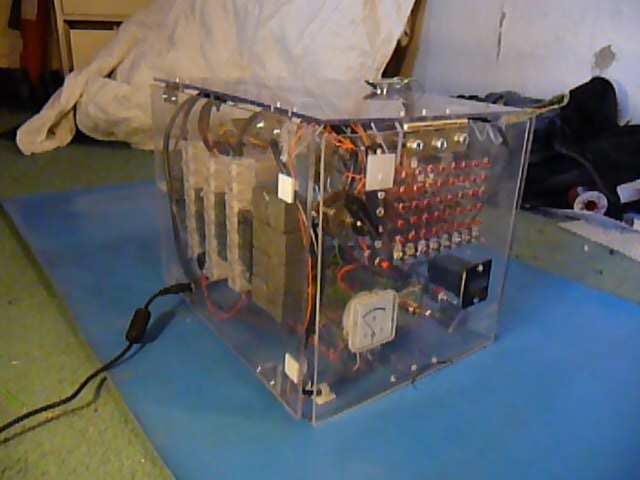
The latest creation I have seen was built by Rory Mangles and christened TIM-8. It is the 8th in a series of increasingly complex and refined builds the last of which qualifies as a complete computer with input/output and processing abilities.

The TIM-8 8-bit relay computer using on 152 relays.
Check out the YouTube video below for an example of TIM-8 executing a program from papertape.