Showing posts with label micro-controller. Show all posts

Tuesday, March 27, 2012

Now I understand - Measuring capacitance with a micro-controller

The excellent article by Rajendra Bhatt explains not only how capacitance can be measured but also how a micro-controller can be interfaced to an analog circuit to create a useful piece of test equipment.


Capacitance meter by Rajendra Bhatt
I found the explanation of the RC time constant method of measurement as interesting as the micro-processor project itself and congratulate Raj on demonstrating a practical and workable real-life example of what can normally be a dry textbook subject.

Click here : http://embedded-lab.com/blog/?p=4400 to read the article which includes everything you need to duplicate his project. 

The page is part of the excellent http://embedded-lab.com/ web site which is well worth a look. I know it is going in my bookmarks and RSS feed.

Monday, January 30, 2012

Twittering Morse Key - Tworsekey


I'm certainly not the first to theorize that if there is a greater than zero probability of something happening then you'll find it happening on the Internet. So it was when I stumbled across this home brew creation of Martin Kaltenbrunner. Martin has created a Morse code key that decodes whatever you hammer out and sends it to a Twitter account, thus neatly bridging more than 160 years of history while ranking fairly high on the, "But why?" scale. I have no idea why Martin created the Tworsekey but you have to admit that it looks great and I wouldn't mind having one siting on my desk.


Wednesday, January 18, 2012

Remarkable relay computer - The TIM-8

Computers don't really make very impressive noises now-days. Hard drives whir and cooling fans exhale white noise, you might detect the quite chatter of disk access or the groan of a failing fan but that is about it.

Rewind a few tens of years and computers used to make really impressive noises that matched their impressive size. A virtual symphony of noise told you that things were really happening in there, things that could probably take a finger off it you happened to stick it in the wrong place!

1955 computer engineer. Popular Mechanics in 1949 confidently declared: "Computers of the future may weigh no more than 1.5 tons"
Every now and then someone gets the urge to recreate a piece of history, a computer that makes the right kind of noises along with other essential prerequisites like blinkenlights and a paper tape reader.

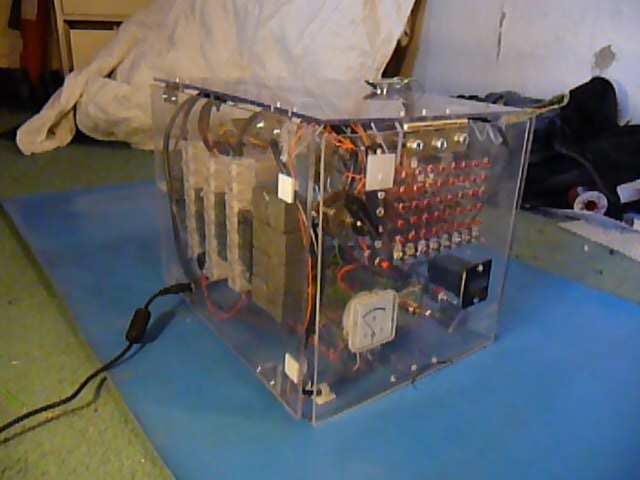
The latest creation I have seen was built by Rory Mangles and christened TIM-8. It is the 8th in a series of increasingly complex and refined builds the last of which qualifies as a complete computer with input/output and processing abilities.

The TIM-8 8-bit relay computer using on 152 relays.
Check out the YouTube video below for an example of TIM-8 executing a program from papertape.

Tuesday, January 17, 2012

Hellschreiber and microprocessors - Bridging more than 80 years

ZL1HIT (Bryan Rentoul) has bridged a gap of more than 80 years by combining the text transmission system developed by Rudolf Hell in the late 1920's with current microprocessor technology.
A sample of received Hellschreiber test from Bryan's beacon
Hellschreiber sends a line of text as a series of vertical columns. Each column is broken down vertically into a series of pixels, normally using a 7 by 7 pixel grid to represent characters. The data for a line is then sent as a series of on-off signals to the receiver, using a variety of formats depending on the medium, but normally at a rate of 112.5 baud.

This process was historically accomplished with mechanical equipment but there are very few examples of this equipment still in operation and it is now sent and received by computer. Hellschreiber is very tolerant of noise and interference and requires only simple transmitters and receivers to work effectively.

German Hellschreiber unit in operation
With a microprocessor generating the digital on-off signals a simple crystal oscillator transmitter can be used to form a beacon station, one that transmits a call sign and perhaps some other information over and over. Changing the transmitted message is as simple as reprogramming the microprocessor or having it respond to a connected input, for Eg. A thermometer, light sensor, switch, etc.

Receiving the signal and decoding requires a radio receiver capable of CW reception and a computer running any of several free software packages like FLdigi or Digital Master 780.

The ZL1HIT beacon using a PIC microprocessor and a simple crystal oscillator transmitter.
For more information and the PIC microprocessor source code please visit the web page of Bryan Rentoul here : ZL1HIT Hellschreiber / PIC Beacon

Tuesday, December 6, 2011

Quick Iambic keyer using the Arduino micro-controller

With the multitude of inexpensive development boards like the Arduino it has become possible to add micro-controllers to just about everything. Projects that previously required custom designed circuits are now implemented by connecting to the input and output ports on a development board. Programming has become easier as well due to the development of simple and efficient software with libraries of sample code to modify and reuse for your own projects.

Costs have fallen dramatically with the development board featured below selling for approximately $30. At that price it could be the heart of automatic antenna tuners, rotor controllers or a keyer as shown below.


Dimitris Sapountzakis quickly home-brewed a set of touch paddles from spade connectors and perf board. 

Touch paddles made from spade connectors and perf board.
Once connected to the Arduino micro-controller he was able to use those inputs to control they keyer code he wrote. Because the logic is in software rather than hardware he could add automatic ID, contest modes or practically any any other function as simply as changing a few lines of software.

With micro-controller prices being as low as they are now we may start to see a renascence in home-brewing and kit building. Much as ham radio kits educated an earlier generation, economical micro-controllers may allow this generations an avenue to experiment, design and create tomorrow technology.

Sunday, December 4, 2011

Build your own computer for $40 ? yes you can ...

FIGnition is a simple, educational computer, but a real one, not an emulator. It has real firmware, real RAM, really generates a display, really has storage for when you turn the machine off (roughly the size of an 80s floppy disk).

I remember kits like this from when I was a kid but they were never so simple to get up and running as the FIGnition. This is a great learning tool for schools or individuals who want to explore computer internals.

Click here to go to the FIGnition site : https://sites.google.com/site/libby8dev/fignition

FIGnition is a $40 educational DIY computer which works like an 8-bit home Micro: outputting to composite video and ready to be interactively programmed from the moment you switch it on. It has  8Kb of RAM; 384Kb of storage; an 8-key keypad and runs a variant of FIG-Forth. It uses USB for power; firmware upgrades and program downloads.